|
About AC-3
AC-3 stands for Audio Coding. A coding system used by Dolby Digital™. Digital Audio Coding is most often referred to as "perceptual coding" simply because a perceptual coding seeks to eliminate the data we can't hear, while maintaining all the data we can hear. AC-3 is often used interchangeably with Dolby Digital.
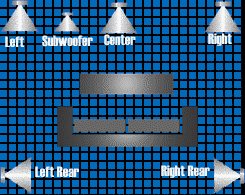
Dolby Digital (AC-3) Surround Sound incorporates six discrete digital audio channels to provide a full immersion surround sound system that is similar to that of a movie theatre. The six channels includes the front - left and right, rear - left and right, the center, and the subwoofer. See figure below: |
|
|
The Dolby Pro Logic Surround Sound, on the other hand provides a single limited-bandwidth (100 Hz to 7,000 Hz) surround channel which is typically played back in the home through two channels of amplification and two speakers. In comparison, Dolby Digital (AC-3) provides separate (discrete) left surround and right surround channels, for more precise localization of sounds and a more convincing, realistic ambience. And, with Dolby Digital, all five main channels are full range (3 Hz to 20,000 Hz).
The sixth channel, the Low Frequency Effects Channel, contains additional bass information to maximize the impact of scenes such as explosions, crashes, etc. Because this channel has only a limited frequency response (3 Hz to 120 Hz), it is sometimes referred to as the ".1" channel. When added to the 5 full range channels, the Dolby Digital system is sometimes referred to as having "5.1" channels.
All six channels in a Dolby Digital system are digital, which means that they can be transferred without loss from the amplifier to your DVD system.
The Dolby Digital (AC-3) Surround Sound requires a Dolby Digital (AC-3) receiver/amplifier to decode the signal. |